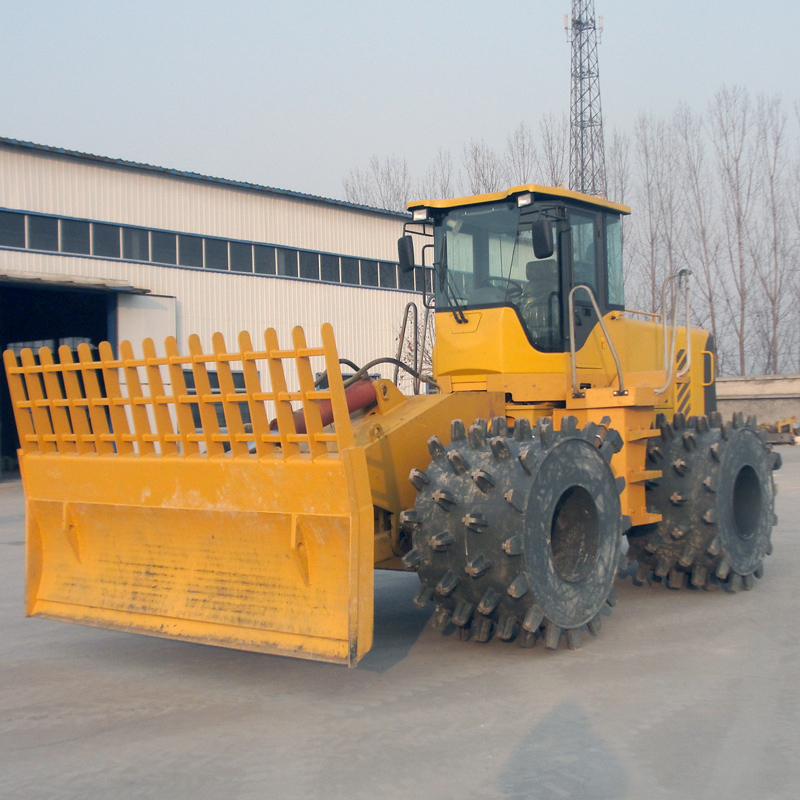
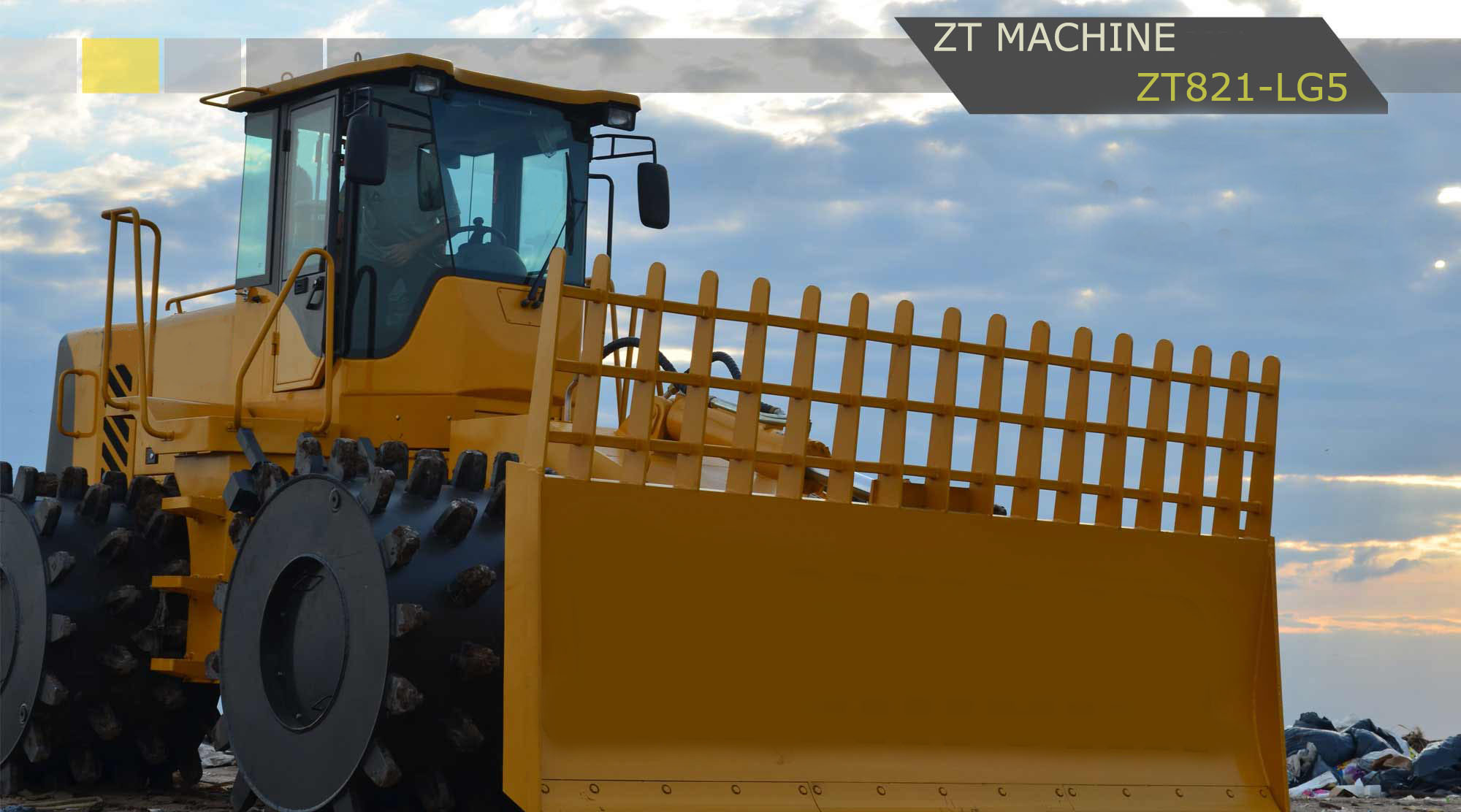
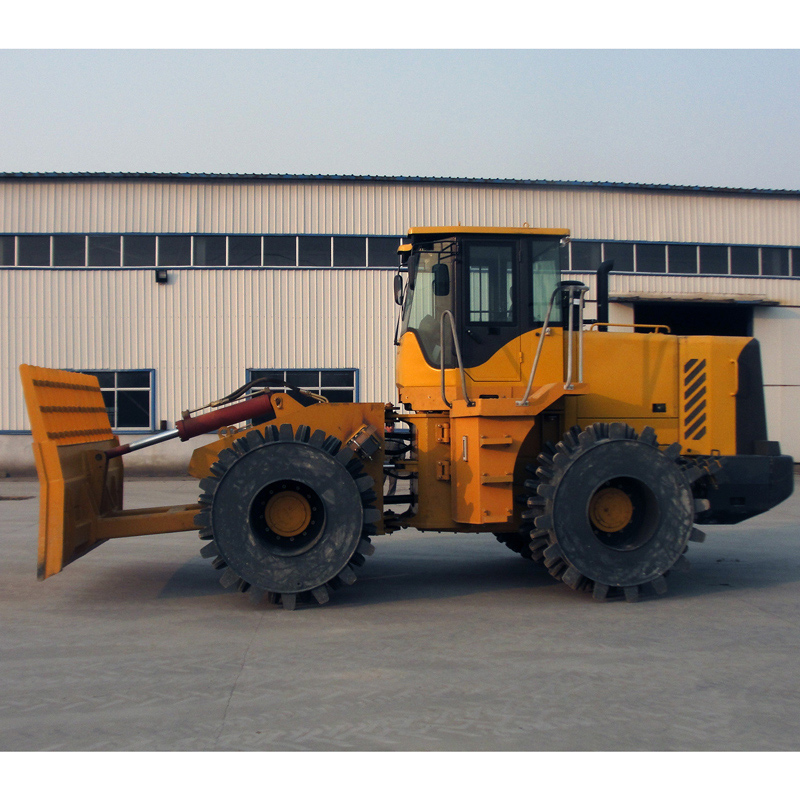
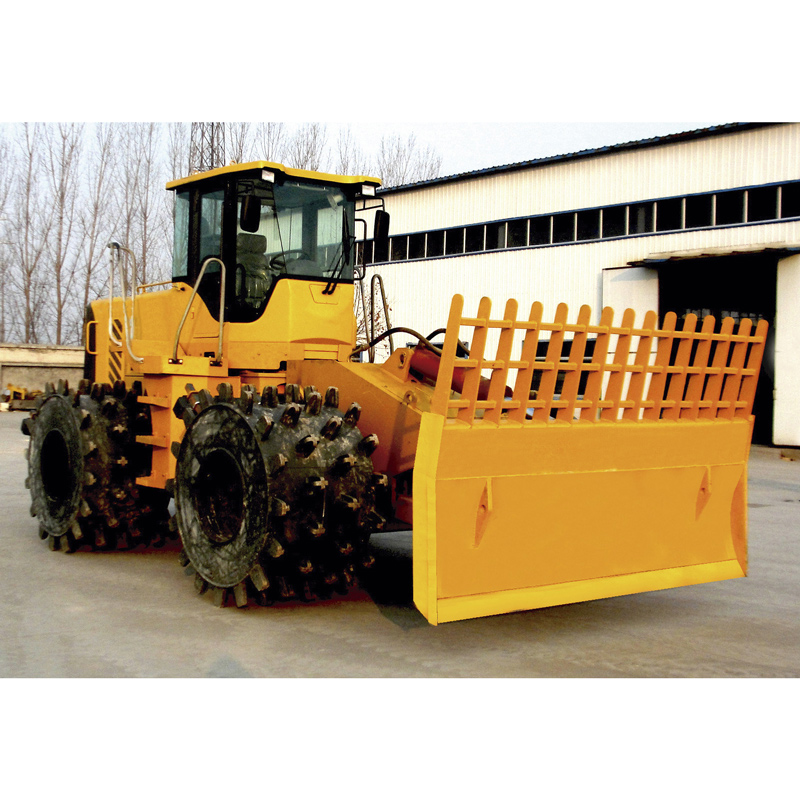
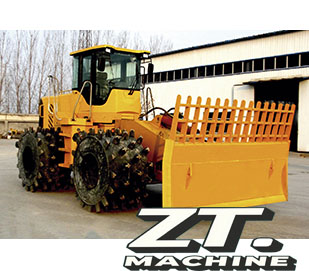
ZTMACHINE ZT821: Landfill Compactor — 21,000 kg, Weichai 162 kW
The ZT821 Landfill Compactor is a 21,000 kg machine built for one job: crush waste, reduce volume, and keep a landfill cell operating on schedule. Powered by a 162 kW Weichai WD10G220E23 engine with 4-wheel drive and 64 carbide-tipped compaction teeth across four 900 mm-wide wheels, it delivers the density gain that extends site life and defers the cost of new cell construction.
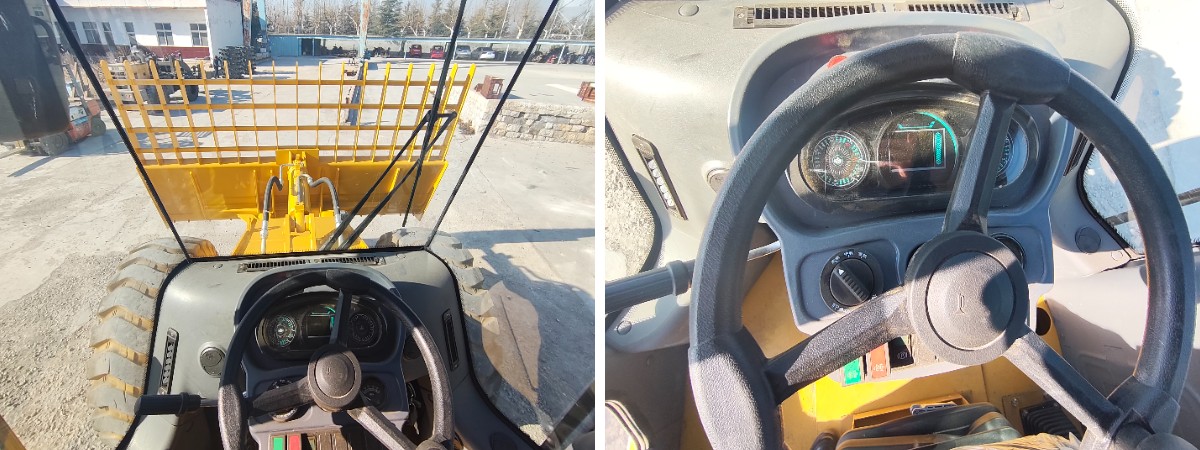
We designed this machine for operators who work wet, abrasive, high-load conditions every shift — not for a showroom. Controls are laid out for immediate orientation: joystick steering, push-blade raise/lower, forward/reverse shuttle, all within arm's reach of the suspension seat. Maintenance intervals are grouped around common service points: engine oil, hydraulic return filter, fuel/water separator, and axle breathers accessible without removing guards.
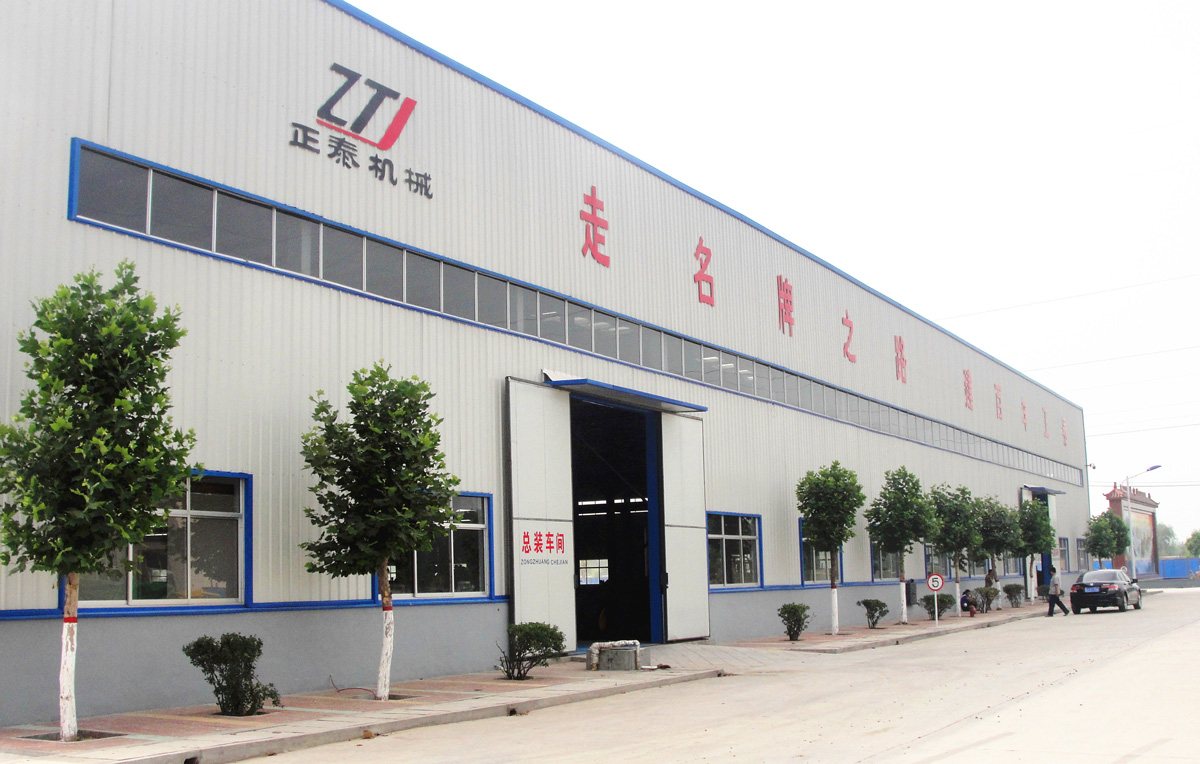
Manufactured in the Shandong construction machinery cluster — a region with more than 20 years of heavy equipment production and Chinese construction machinery export history — the ZT821 is built to global dimensional standards. It fits one unit per 40HQ container with the push blade detached and crated alongside, reducing ocean freight cost compared to machines that require flat-rack or break-bulk shipping.
As a loader manufacturer and landfill compactor producer, we supply the ZT821 at factory price with a documented quality system. Each unit leaves the plant with a test certificate, engine data sheet, and a parts manual that cross-references heavy equipment components to standard catalogue numbers — so replacement parts can be sourced locally in year two and year five.
🔧 What Problems the ZT821 Solves on Site
1. Waste volume that eats up airspace too fast
The ZT821 applies 21,000 kg through four 1,600 mm-diameter wheels fitted with 64 teeth arranged in a staggered pattern. Each pass shears and compacts refuse into a denser layer than a tracked dozer or a standard rubber-tyre compactor can achieve on the same material. Operators report fewer passes to reach the target density, which directly translates to longer cell life and lower per-tonne disposal cost.
2. Downtime from wheel wrap, debris penetration and hydraulic leaks
The wheel design uses a closed rim with welded-on cleats and replaceable carbide tips — no wire wrap between tyre and rim, no sidewall punctures. The undercarriage is protected by steel belly pans; the hydraulic hose routing stays inside the frame rail, away from falling debris. The 155 L hydraulic circuit runs through spin-on return filtration, and the Weichai engine's dry-type air cleaner has a pre-cleaner and a restriction indicator, so the operator knows when to service rather than guessing.
3. Fuel consumption that eats the operating budget
The Weichai WD10G220E23 is a six-cylinder, turbocharged, direct-injection diesel rated at 162 kW. It is not an electronically governed common-rail engine — it is a mechanically controlled, field-repairable unit that runs on standard diesel without requiring ultra-low-sulphur fuel. The torque curve is flat from 1,400 to 1,800 rpm, which means the operator can work in the economical band without constant downshifting. Fuel consumption is managed by the gearbox match: two forward speeds (0–4.2 and 0–15.7 km/h) and one reverse (0–5.8 km/h) keep the engine loaded in the efficient zone during compaction passes.
4. Operator fatigue in long shift cycles
The cab is mounted on four rubber isolators with a Grammer-style suspension seat.
5. Transport cost and logistics complexity
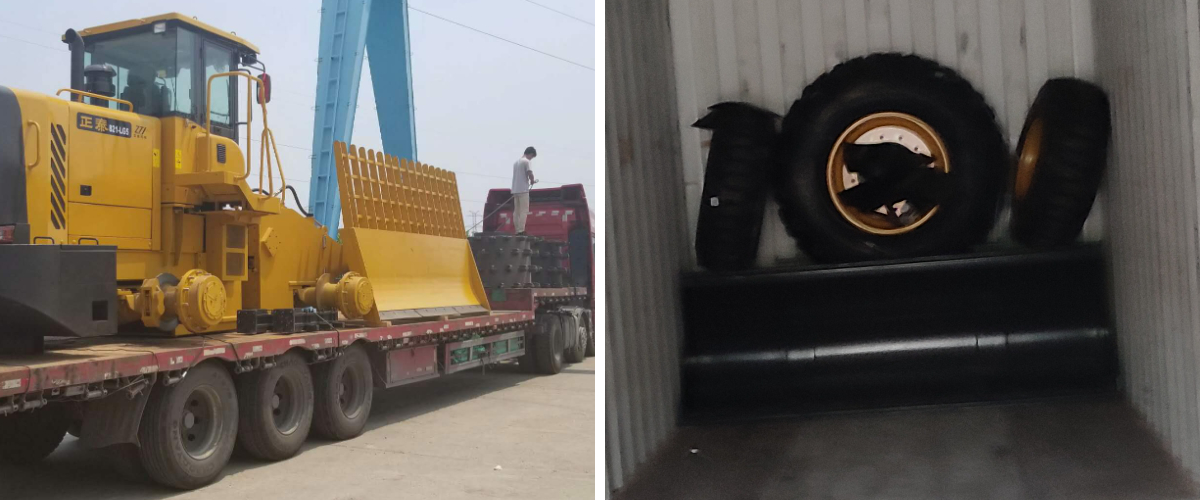
Overall dimensions: 7,000 mm long, 3,350 mm wide (over push blade and both axles), 3,530 mm high. With the push blade removed and crated, the ZT821 loads into a standard 40HQ container. The machine is driven onto steel skids, lashed at eight frame points, and the blade crate slides in beside it. This eliminates the need for flat-rack booking, reduces ocean freight by approximately 30–40% compared to break-bulk, and avoids port congestion delays associated with specialised vessels.
🌍 20+ Years of Heavy Equipment Export — How It Shapes the ZT821 Delivery
The machine is configured for your waste stream, not for a brochure
Before we finalise the build sheet we ask: what is the dominant waste type — municipal solid waste, construction and demolition debris, industrial sludge, or mining overburden? Each material affects the tooth configuration, the push-blade wear-plate thickness, and the cooling pack specification. A machine headed for a coastal landfill in Southeast Asia gets a different corrosion-protection spec than one going to a high-altitude site in South America. We adjust the build based on your site description, not on a generic template.
Components are chosen for local repairability
The Weichai engine is supported by a global dealer network; the hydraulic pump, control valve and cylinders are from recognised brands whose seal kits and cartridge kits are stocked by major parts distributors. The wheel cleats and carbide tips are sold as individual pieces, so a damaged tooth is replaced in minutes rather than requiring a full wheel assembly.
Documentation that meets customs requirements on first submission
Every ZT821 ships with: commercial invoice, packing list, bill of lading, certificate of origin. The packing list matches the container stowage plan line by line, so customs inspection — if triggered — confirms the declared contents without delay.
🏗️ Where the ZT821 Operates
Municipal solid waste landfills — daily cell compaction, cover material spreading, access road maintenance
Construction and demolition debris sites — crushing concrete slabs, compacting mixed rubble, levelling haul roads
Industrial waste facilities — ash, sludge cake, filter cake compaction and stacking
Mining overburden and tailings storage — waste rock compaction, tailings dam access ramp grading
Transfer station receiving floors — pushing inbound waste into the pit, compacting trailers for outbound haul
Landfill gas capture projects — maintaining a dense cap surface for gas collection system integrity
Rental fleets supplying landfill operators — one machine covering multiple cells on a rotating contract basis
Bioreactor landfills — working wet, biologically active waste without traction loss or wheel clogging
⚙️ Design Decisions That Matter in Daily Operation
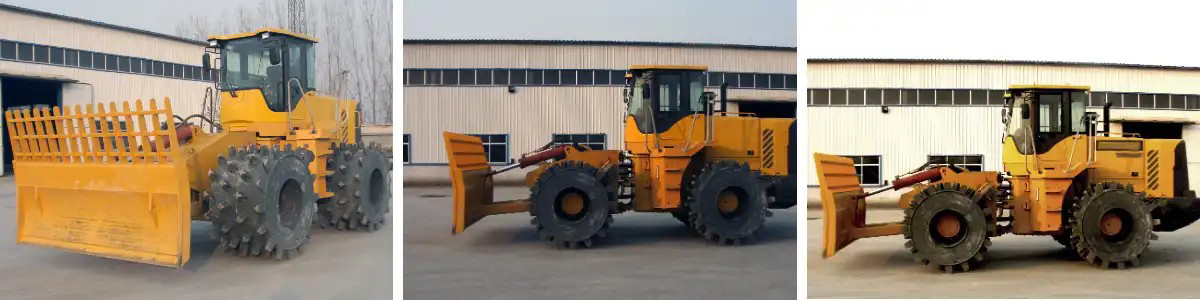
Four driven wheels, 64 carbide-tipped teeth. Each wheel is independently driven through a planetary final drive; the tooth pattern overlaps between front and rear axles so no strip is left uncompacted.
Push blade: 3,350 mm wide, 1,880 mm tall, 980 mm lift, 150 mm dig. Sized to spread a full truckload in two passes without spill-over. Float detent lets the blade follow the contour of the working surface automatically.
Articulated steering: ±40° articulation, ±15° lateral oscillation, 6,085 mm turning radius. The machine turns inside its own length, so it can reverse direction in a single lane of the tipping platform without a three-point manoeuvre.
Brake system: pneumatic-hydraulic service brakes on all four wheels, mechanical spring-applied parking brake. If air pressure drops below the threshold, the parking brake applies automatically — no roll-away risk on sloping cells.
24 V electrical system, dual batteries, sealed connectors. Designed to start reliably in ambient temperatures down to -15 °C without a block heater.
Optional axle configurations. Standard ordinary axle with two-stage emission engine, or wet-disc brake axle with three-stage emission engine — selected based on local regulation and operating conditions.
📐 ZT821 Landfill Compactor — Full Technical Specification
Factory-rated values. Verify against the signed pro-forma invoice before ordering; optional configurations (wet-brake axle, tier III engine) may alter weight and dimensions slightly.
| Description | Unit | Specification | |
|---|---|---|---|
| Equipment weight | kg | 21,000 | |
| Dimensions | Length | mm | 7,000 |
| Width (push blade) | mm | 3,350 | |
| Width (front wheel outside) | mm | 3,350 | |
| Width (rear wheel outside) | mm | 3,350 | |
| Height | mm | 3,530 | |
| Wheelbase | mm | 2,750 | |
| Ground clearance | mm | 280 | |
| Compaction wheels | Pressure roller width (front/rear) | mm | 900 |
| Roller diameter over teeth | mm | 1,600 | |
| Roller body diameter | mm | 1,290 | |
| Number of teeth (total) | pcs | 64 | |
| Powertrain | Engine manufacturer | — | WEICHAI |
| Model | — | WD10G220E23 | |
| Power | kW | 162 | |
| Rated speed | r/min | 2,000 | |
| Electrical system | V | 24 | |
| Number of driving wheels | — | 4 | |
| Travel speed | Forward I | km/h | 0–4.2 |
| Forward II | km/h | 0–15.7 | |
| Reverse | km/h | 0–5.8 | |
| Push blade | Blade height | mm | 1,880 |
| Blade width | mm | 3,350 | |
| Blade lift height | mm | 980 | |
| Blade dig depth | mm | 150 | |
| Brakes | Service brake | — | Pneumatic-hydraulic, 4-wheel |
| Parking / emergency brake | — | Mechanical spring-applied, uplift | |
| Steering | Type | — | Hydraulic, centre-articulated, pendulum |
| Articulation angle | — | ±40° | |
| Lateral oscillation | — | ±15° | |
| Turning radius (front wheel outside) | mm | 6,085 | |
| Optional Configurations | |||
| Standard ordinary axle + two-stage emission engine | |||
| Wet disc brake axle + three-stage emission engine | |||
📦 Container Loading, Shipping and Delivery
Container fit. The ZT821 is dimensioned to load one unit per 40HQ container. The push blade is removed, and placed beside the machine.
Preparation for sea freight. Machine is washed. The articulation joint is locked straight, and the machine is chained at four frame points with tensioners.
Lashing and stowage. Steel chocks are welded to the container floor ahead of and behind each wheel.
Documentation. Commercial invoice, packing list, bill of lading, certificate of origin. All documents are prepared in English; translations to Spanish, French, Arabic or Portuguese are available on request at no extra charge.
Delivery timeline. Production lead time is typically 25–35 days from deposit confirmation. Ocean transit varies by route: 18–25 days to most African ports, 22–30 days to South America, 12–18 days to Southeast Asia. We quote CIF or FOB — specify your discharge port and we return a line-item price breakdown.
Product Details
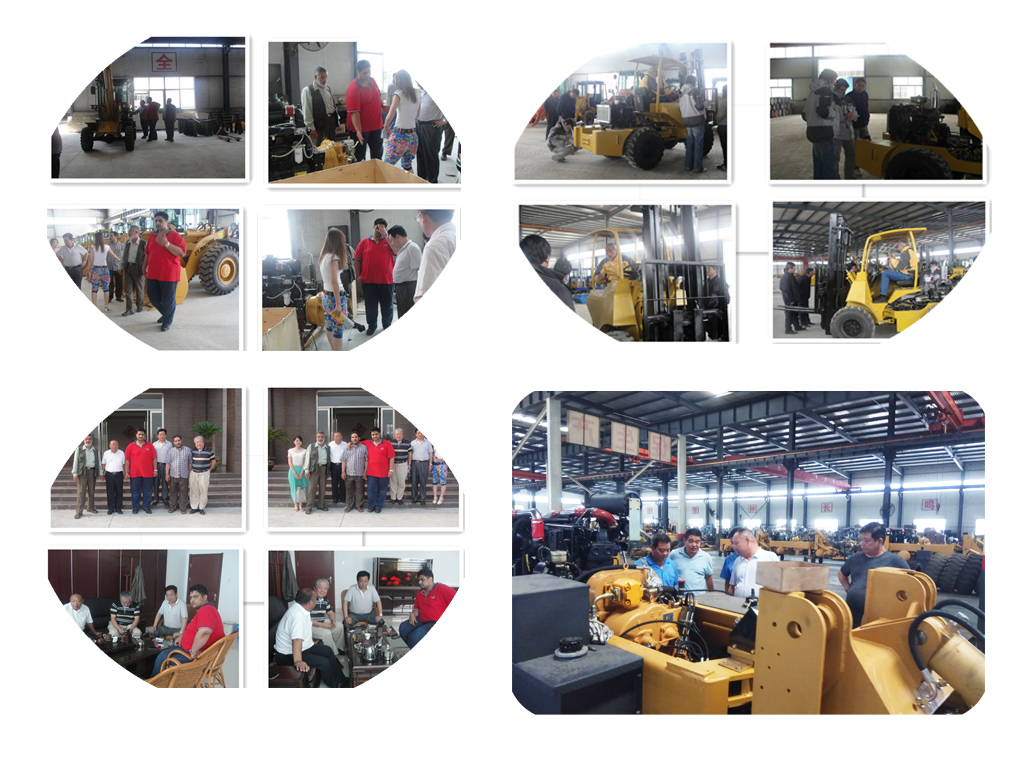
Client Visit
❓ Frequently Asked Questions
What quality certification does the ZT821 compactor have?
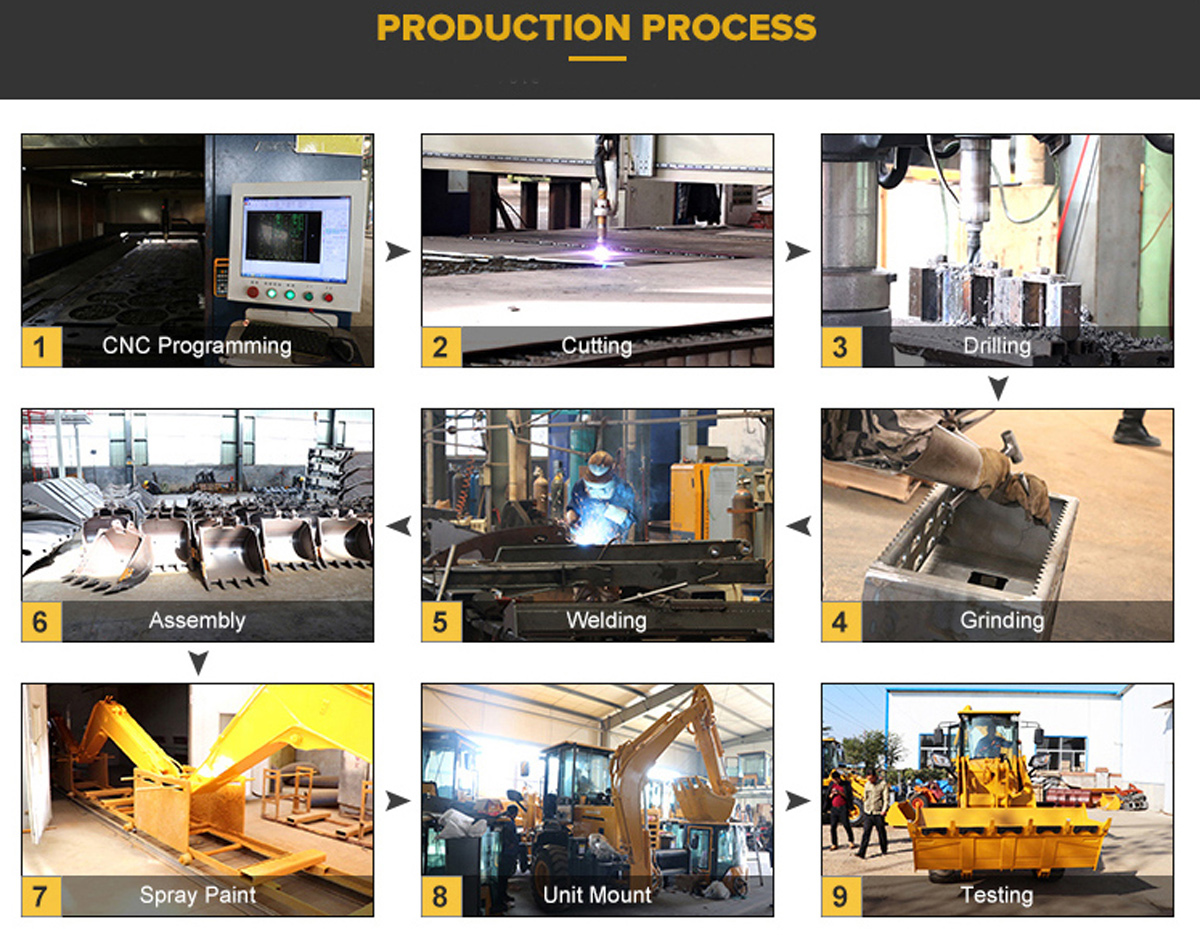
The ZT821 is manufactured in a facility whose quality management system is certified to ISO. Every unit passes a documented inspection routine: engine run-in, hydraulic pressure test, push-blade function test, wheel-tooth torque check, and a 30-minute compaction simulation on a test pad.
How does the 40HQ container loading plan work?
The ZT821 is dimensioned to fit one unit per 40HQ container with the push blade removed and crated. The machine is driven onto steel skids, lashed at eight frame points, and the blade crate is secured beside it. This eliminates the need for flat-rack booking, reduces ocean freight by approximately 30–40% compared to break-bulk, and avoids port congestion delays associated with specialised vessels. We send the stowage drawing and lashing photos with the shipping documents.
Do you offer factory price and wholesale options?
Yes. As a manufacturer, we quote factory-direct pricing on all orders — single units and container-quantity lots. The price includes the machine, the push blade, the wear-parts kit, and the operator and parts manuals. Bulk orders (three or more units per shipment) qualify for a volume discount that is calculated per-container rather than per-machine. Send the destination port and the quantity, and we return a line-item FOB or CIF quotation.
What after-sales support do you provide?
The ZT821 carries a 12-month or 2,000 operating-hour warranty, whichever comes first, covering manufacturing defects in the frame, drivetrain, hydraulics and electrical system. Wear items (teeth, cutting edges, seals, filters, hoses, tyres) are excluded by name. The Weichai engine is covered by the maker's own warranty and global dealer network
Can this compactor handle complex landfill conditions?
Yes. The ZT821 is designed for wet, abrasive, high-load waste environments. Key features that address these conditions: 4-wheel drive with planetary final drives, 64 replaceable carbide-tipped teeth that penetrate and shred without wrapping, steel belly pans protecting the undercarriage, and a mechanically injected engine that runs on standard diesel. For extreme conditions such as bioreactor landfills with elevated moisture and biological activity, the optional wet-disc brake axle provides additional corrosion resistance and braking reliability.
I searched "compactors near me" — can you still supply?
Yes, and the "near me" part is a freight question. We ship from Qingdao and Tianjin ports to most global destinations on regular liner rotations. Tell us the discharge port (or the inland city if you want truck-freight included to your yard) and we return a landed quote with ocean freight, insurance and port handling broken out separately. If a local dealer has a used unit that fits your budget, compare it against our factory price on delivered cost per operating tonne — send the port and quantity and we will put the number in front of you.
What is the difference between the standard axle and the wet-brake axle option?
The standard configuration uses an ordinary axle with a two-stage emission engine — suitable for most landfills where the machine operates on compacted waste surfaces with moderate dust and moisture. The wet-disc brake axle option pairs with a three-stage emission engine and features fully enclosed, oil-cooled brakes that resist contamination from mud, leachate and fine particles. Choose the wet-brake option if your site has standing water, high rainfall, or if the machine frequently works on slopes where brake fade resistance is critical. Both options are priced separately — we can quote both configurations side by side.
Payment terms, deposit, and can I inspect before shipping?
Standard terms: 30% deposit against the pro-forma invoice, 70% against copy shipping documents. Third-party inspection (SGS, BV, Intertek or your own agent) is welcome at the plant — book it into the production slot so the machine is ready for inspection before the balance payment. You can also attend the factory acceptance call via video link.
✉️ Request a Build Sheet and Firm Delivered Price
Email: woniuniu9527@163.com
Include: destination port or inland city · quantity · intended waste type (MSW, C&D, industrial) · preferred axle configuration (standard or wet-brake) · CIF, CFR or FOB.
You will receive a marked-up build sheet, a line-item factory price quotation, the container stowage plan and the document list — usually within one working day.


