Troubleshooting Guide: Why Is My Loader’s Hydraulic System Losing Power?
Troubleshooting Guide: Causes and Solutions for Insufficient Power in the Loader Hydraulic System
Have you noticed that the bucket moves more slowly and the lifting force decreases? Insufficient power in the hydraulic system is a common problem, but it doesn't mean a major overhaul is needed every time.
Common Symptoms of Hydraulic Power Loss
Slower bucket movement and reduced operational speed
Decreased lifting force and reduced load capacity
Unusual noises from hydraulic system during operation
Systematic Troubleshooting Steps
You can check according to the following steps, starting with the simplest and most common issues:
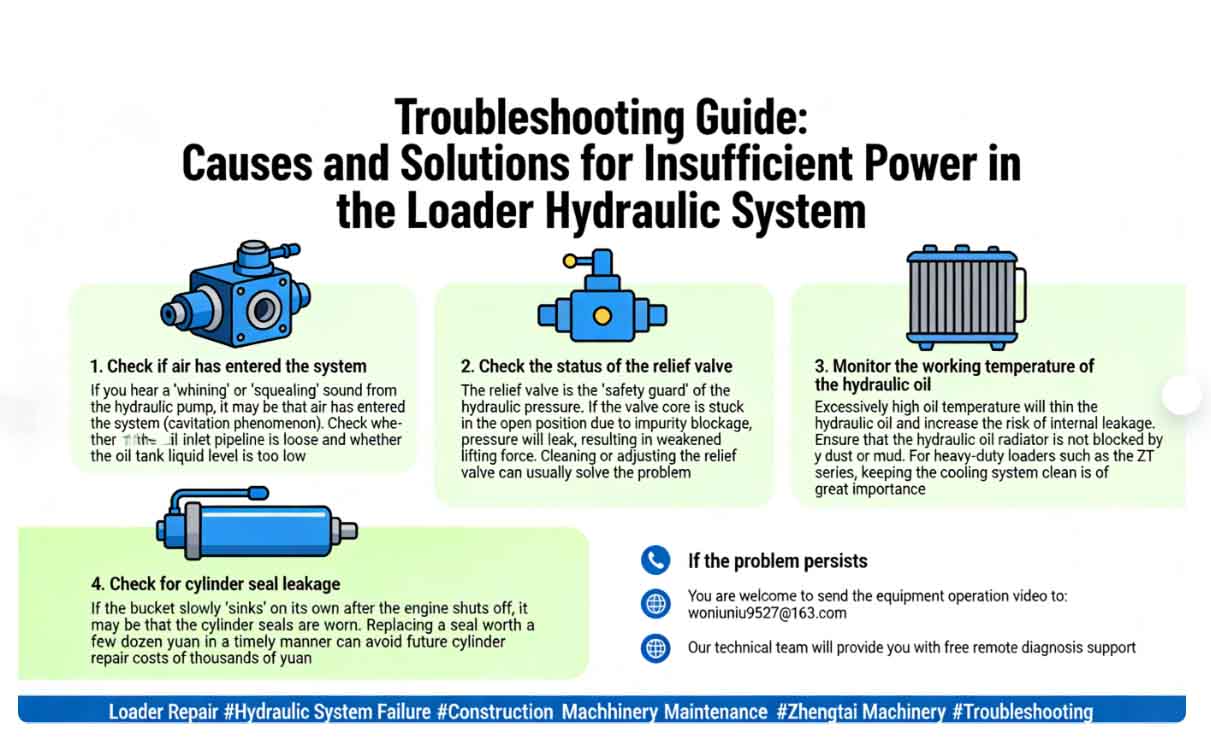
Check if Air Has Entered the System
If you hear a "whining" or "squealing" sound from the hydraulic pump, it may indicate that air has entered the system (cavitation phenomenon). This is one of the most common causes of reduced hydraulic power.
Diagnostic Checks:
Check whether the oil inlet pipeline is loose or damaged
Verify the oil tank liquid level is at the proper level (not too low)
Listen for unusual pump noises during operation
Check for foaming in the hydraulic oil reservoir
Inspect all hydraulic line connections for tightness
Check the Status of the Relief Valve
The relief valve is the "safety guard" of the hydraulic pressure. If the valve core is stuck in the open position due to impurity blockage, pressure will leak, resulting in weakened lifting force.
Relief Valve Inspection:
Clean or adjust the relief valve (usually solves the problem)
Check for contamination in the hydraulic fluid
Test pressure settings with a hydraulic pressure gauge
Inspect valve spring for proper tension
Replace relief valve if cleaning doesn't restore function
Monitor the Working Temperature of the Hydraulic Oil
Excessively high oil temperature will thin the hydraulic oil and increase the risk of internal leakage. This reduces system efficiency and can cause permanent damage to hydraulic components.
Temperature Management:
Ensure the hydraulic oil radiator is not blocked by dust or mud
For heavy-duty loaders such as the ZT series, keeping the cooling system clean is critical
Monitor operating temperature during normal work cycles
Check for proper fan operation and airflow
Use correct viscosity oil for your operating conditions
Check for Cylinder Seal Leakage
If the bucket slowly "sinks" on its own after the engine shuts off, it may indicate that the cylinder seals are worn. Internal leakage in hydraulic cylinders is a common cause of power loss.
Cylinder Seal Diagnostics:
Perform a "drift test" - observe cylinder movement with engine off
Check for external oil leakage around cylinder rods
Inspect cylinder rods for scoring or damage
Listen for internal leakage sounds during operation
Test cylinder performance under load
Preventive Maintenance vs. Repair Costs
Replacing a seal worth a few dozen yuan in a timely manner can avoid future cylinder repair costs of thousands of yuan. Early detection and repair of hydraulic issues saves significant time and money.
Timely preventive maintenance
After complete failure
If the Problem Persists...
Some hydraulic issues require professional diagnosis. Our technical team provides free remote support to help you identify complex hydraulic system problems.
Free Remote Diagnosis Support
You are welcome to send the equipment operation video to our technical team for analysis.
What to include in your video:
• Clear footage of the loader during operation
• Close-ups of any unusual sounds or movements
• Video of the hydraulic system during startup
• Footage showing the problem under load
• Any warning lights or gauges showing abnormal readings
Our hydraulic specialists typically respond within 24 hours with preliminary diagnosis and recommended solutions.